
Basics
What is coconut sugar? From coconut sap to crystal
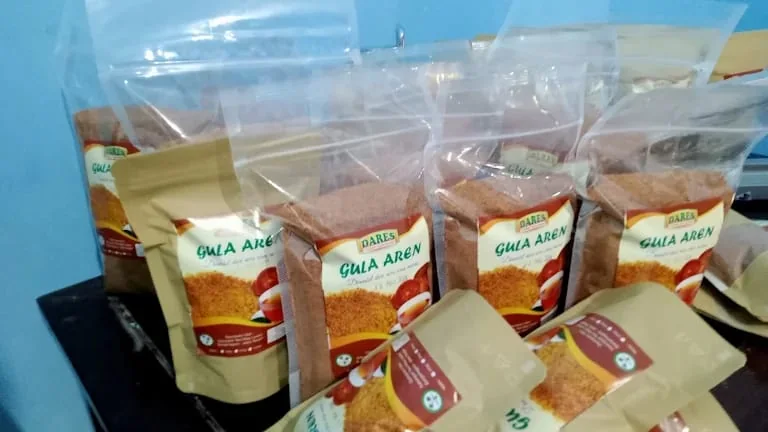
Coconut sugar is sugar made from coconut sap, cooked until thick, then stirred as it crystallises so that it sets into coarse, light brown grains. In older recipe books this form is sometimes called coconut sugar crystal or simply gula semut.
If you have ever bought coconut sugar shaped into a hard cup or cylinder, the raw material is the same. The only difference is the final step: stirred, or left to set.
Why Indonesians call it “ant sugar”
Not because there are ants in it. The name comes from the look: the grains are small and clustered, like a swarm of ants gathered around sugar left on a table.
The name also separates it in the market. If you ask for gula kelapa at a traditional market, what arrives is usually block sugar the size of a fist. Ask for gula semut and you get a bag of grains.
Where the raw material comes from
Both are sap, both produce sugar, but they are not identical:
- Arenga sap (Arenga pinnata) gives a darker sugar, a stronger aroma and a higher yield. One litre of arenga sap yields roughly 100–130 grams of sugar.
- Coconut sap gives a lighter colour and a softer taste. In some regions coconut sugar is preferred for cakes because it does not dominate the flavour.
Both are legitimately called coconut sugar. What is not legitimate is blending it with white sugar — and that is unfortunately common, because white sugar is far cheaper.
How it differs from block coconut sugar
| Aspect | Coconut sugar crystals | Block coconut sugar |
|---|---|---|
| Form | Coarse grains | Solid, moulded in shell or bamboo |
| How to use | Spoon straight in | Shaved, chopped or melted |
| Dissolving | Quick, even in cold water | Slow, needs hot water |
| Moisture | Usually 2% | Higher, 8–12% |
| Shelf life | Longer in a sealed container | Shorter, prone to mould |
| Best for | Coffee, cakes, toppings, milk coffee | Curries, sambal, coconut desserts |
The process is short, but not easy
Broadly there are five stages: sap is tapped morning and evening, filtered, cooked in a wok until thick, stirred as it begins to crystallise, then sieved and dried. The whole run from tapping to dry grain takes about four to six hours.
The hardest part is the fourth stage. Stir too early and the sugar sets into one solid lump. Stir too late and it hardens like stone and has to be thrown away. Makers judge the moment by the texture of the sugar as they stir — not by the clock. The full account is in our article on how coconut sugar is made.
Frequently askedCoconut sugar can replace white sugar at a 1:1 ratio. Because the grains are coarser and absorb more water, reduce the liquid in a baking recipe by about 5%.
Taste and aroma
Coconut sugar has a deeper sweetness than white sugar, with a caramel finish that lingers on the tongue. Cooked over a wood fire it carries a faint smokiness — some people love it, some do not. That aroma fades after two or three weeks in a closed pack.
The colour is never uniform. Batches made in the dry season are usually lighter because the sap is not diluted by rain. Sugar that looks exactly the same all year round is worth being suspicious of, because it usually contains dye.
Storing it
Coconut sugar draws moisture out of the air. Keep it in a tightly closed container, away from the stove. If it clumps, that does not mean it has spoiled — just press it loose or sieve it before use. What does signal spoilage is a sour smell, or furry white patches.
So, in short
The grain form is a practical way to use coconut sugar without shaving it every morning. The raw material is sap, the process is traditional, and the grain form exists because it is deliberately stirred as it crystallises. If you want to know how to pick a genuinely pure product in the market, continue to our guide to telling real coconut sugar from the blended kind.
Try a small bag first.
Packs start at 250 g. If it is not to your taste, there is no need to order in bulk.